Traditional Puglia taralli are made with a simple mixture of flour, extra virgin olive oil, white wine and salt, which is shaped into rings and steamed in water before being baked in the oven. It is the steaming process that distinguishes traditional taralli from a common baked snack: it gives the thin crust and friability that make it unmistakable.
In Fiore di Puglia this process, it is the heart of the production. We respect it at every stage, even on an enterprise scale, because that is what makes a tarallo truly Puglia-style. Let’s see it step by step.
The dough: few ingredients, carefully chosen
The dough for Puglia tarallo is firm and free of yeast. The basic ingredients are soft wheat flour, extra virgin olive oil, dry white wine and salt. To these are added the flavors that give the taste: fennel seeds, chili peppers, onion, olives.
The ingredients are worked until a smooth and elastic dough is obtained, which then rests for about 15-30 minutes. The rest period makes it easier to roll out and seal. In our facility, the dough is formed in a dough mixer, with the same attention to proportions and to the traditional recipe times.
The formation: the ring shape
From the mixture small strings of about 0.8-1.5 cm diameter are obtained, which are closed in a ring by overlapping and pressing the ends. This gesture gives rise to the shape that everyone recognizes.
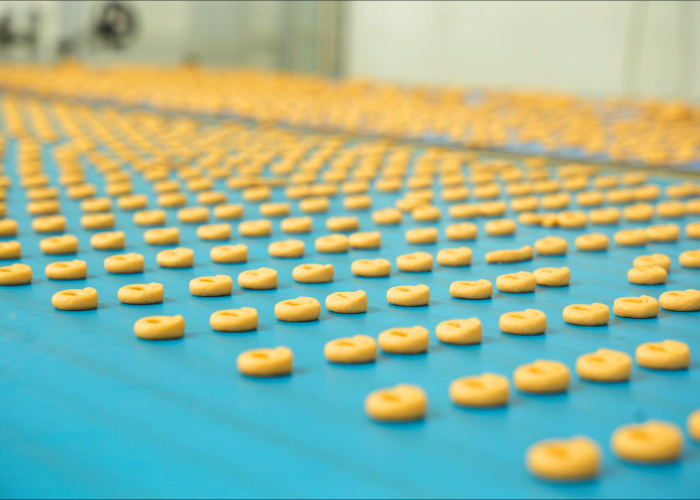
The sizes vary depending on the format. The tarallini measure up to 3 cm in diameter, while the classic taralli measure between 6 and 8 cm. Once formed, the raw tarallini advance on the conveyor belts of the production line, ready for the next step.
Boiling: the step that makes the difference
This is the stage that makes tarallo truly traditional. In the homemade recipe, only a few tarallini are dipped in boiling water at a time and pulled out when they float to the surface after a few seconds.
Boiling sets the shape, creates the crust and contributes to the final friability. Fiore di Puglia It also maintains this quality in large-scale production, in industrial versions: the taralli are passed through a machine that generates steam, which ensures this process is carried out consistently throughout the line. The tool changes, not the function: it is the boiling that gives the taralli its consistency.
Drying
After boiling, the taralli must dry well, from a few minutes to 20-30 minutes depending on size and humidity. This step prevents the taralli from getting “soupy” in the oven and makes them more crispy.
Cooking in the oven
The taralli are cooked at a medium-high temperature, traditionally between 170 and 200 °C for about 20-40 minutes. The exact time depends on the shape, the type of oven and the degree of browning desired.
The result is a dry, crispy and crumbly tarallo, with the surface slightly opaque, a sign of the passage through the water before cooking.
Cooling and packaging
Once baked, the taralli cool completely before being packaged. This is a crucial step to preserve their fragrance and crunchiness over time.
FAQ
Why do Puglia’s taralli boil before being cooked?
Boiling hardens the shape of the tarallo and creates a thin crust that, after baking in the oven, gives it the typical brittleness.
What ingredients are needed for traditional Puglia taralli?
Flour, extra virgin olive oil, dry white wine and salt, with any flavors such as fennel seeds.
At what temperature are the taralli cooked?
Traditionally, between 170 and 200 °C, for about 20-40 minutes.
What is the difference between taralli and tarallini?
It depends mainly on the size: the tarallini measure 3 cm in diameter, while the classic taralli measure 6-8 cm.
How are taralli preserved?
After cooling them completely, in containers or sealed packaging, to maintain the fragrance.